

Beyond the hype: real-world ways marketers are winning with AI today
July 2025
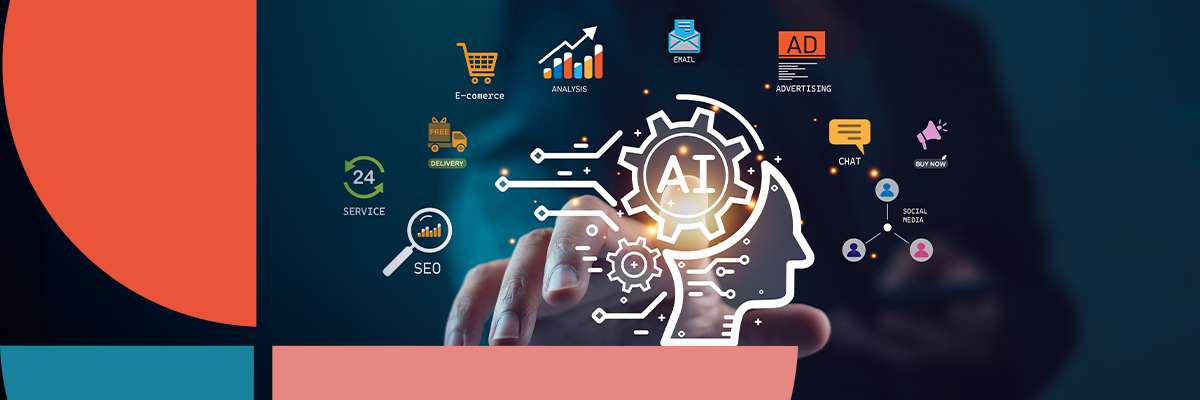
AI is a strong contender for 2025’s word of the year. It feels as if there are few areas where AI’s potential isn’t being tested – and of course, marketing is a prime candidate.
But how is AI used for marketing? Is AI for marketing a threat or an opportunity? When we look beyond the hype, how are marketers today using AI to save time, focus campaigns and refine spend?
In this blog, we explore 9 ways AI is helping marketers right now – enabling them to work faster, smarter and more effectively.
Defining AI
Before we do, it’s probably worth defining what we mean by AI.
Artificial Intelligence is the science of creating machines capable of carrying out tasks that have historically needed human intelligence. Machine learning enables computers to solve problems and make decisions in a human-like way, adding to their knowledge through experience.
Generative AI is arguably the field of AI most relevant and helpful to marketing. What does generative AI mean? Generative or gen AI can create new content – not just text, but images, videos and more – based on existing data. It learns from an existing dataset and uses that knowledge to generate new content with similar characteristics.
Benefits of AI in marketing
Timesaving
AI can take on labour-intensive aspects of marketing, especially those that make use of data, saving marketers time. It can use existing data to create draft content – for example, creating social media posts from a thought leadership document.
Reducing human error
While it’s not infallible (anyone using AI to create marketing content needs to beware ‘hallucinations’, aka false information), AI can reduce the human error potential within data-led marketing marketing activities.
Increasing market intelligence
AI can identify market trends, helping marketers to create relevant content and campaigns. It can carry out competitor analysis quickly, trawling through competitor websites and corporate information far faster than a human could.
Improved customer experience
AI can support your customers and clients with online agents and interactions – and because it’s learning all the time, the ways it can help your customers are getting slicker and more comprehensive.
AI use cases for marketing
So, the potential benefits of AI for marketing are clear.
Let’s explore these a bit more by looking in more detail at some AI and generative AI use cases in marketing.
- Creating thought leadership – one of the most obvious uses for generative AI. AI can help marketers create thought leadership by aggregating existing pieces of content, drawing from numerous sources.While it can definitely save marketers time, it’s probably best to see AI’s role here as a very junior copywriter, and view the draft as a first stab at your content. It’s unlikely to be ‘publish ready’ – drafting is one area where human oversight is definitely needed.
- Editing content – another creative use case for AI in marketing. Whether it’s extracting key messages to create an executive summary or cutting down an over-long piece of writing, AI can be brought to bear.
- Personalisation – using your metrics and data, AI algorithms can suggest content and products tailored to your audience, helping you to create a logical customer journey.
- Creating marketing assets – whether it’s social media posts and tiles, customer emails, infographics or videos, building a library of assets to promote your signature thought leadership and products can be really time-consuming. AI can dramatically cut the time marketers need to spend on this, creating draft marketing assets for you to review and refine.
- Market and competitor analysis – cutting through the noise in the market to help you identify market trends and understand your competitors’ business strategies and marketing campaigns. This can be a big drain on marketing resource, and somewhere AI can definitely pay dividends.
- Campaign optimisation – here, AI can really come into its own. Aggregating and analysing data, and suggesting optimised strategies, is where AI excels. Use it to analyse campaign performance metrics so you can optimise ad spend and targeting. A/B testing can be automated by AI and easily scaled across all your channels.
- SEO optimisation – where AI can take on a number of roles, from analysing keywords to optimising content and marketing assets for online search.
- Marketing automation – AI can automate marketing tasks like social media scheduling and email campaigns, reducing marketing teams’ admin and allowing more time for creativity.
- Improving customer experience – This might mean the targeted customer journey we touched on above; using AI to enable you to deliver focused content and insights. AI-driven chatbots, agents and other online support also help your clients and customers, and are constantly learning in order to tackle increasingly complex queries with greater sophistication.
There are clearly plenty of opportunities for marketers to make use of AI to save time, increase campaign rigour and targeting, support content creation and deliver robust data insights.
When looking at how to use AI in marketing, we shouldn’t neglect the areas where you should be a little wary.
We’ve touched on this above, but there are some aspects of marketing where human oversight is definitely preferable to giving AI free rein.
- Compliance and approvals. AI is getting cleverer all the time, but if you are a regulated business whose activity is governed by the FCA or other regulator, you’ll need to be 100% confident that your content is compliant and has been through the correct review and approval process.
- Content and thought leadership as a whole – not just in terms of compliance – is somewhere where you cannot leave AI to its own devices. We mentioned ‘hallucinations’ – the term used where AI presents inaccurate information as fact. Even if your content is factually correct, AI will not always write it in the most fluent way. You’ll want to proofread and copy-edit as you would if it had been written by the most junior member of your team.
- Data management. As with any computer or process, the data out will reflect the data in. If your campaign data or the other metrics you feed into AI are not accurate or complete, the analysis you get won’t be either. A sense check is always needed.
- Impersonal customer interactions. AI customer agents can speed responses to consumers and reduce the demands on your in-house teams. But they are still learning and have limitations, among them the ability to detect and play back nuance in customer conversations. You’ll need to keep a close eye on any AI interactions to ensure they are in line with your tone of voice and reflect your customer service ethos.
- Data privacy and ethics. AI’s ability to handle large amounts of data is matched only by the potential for this to cause problems if not managed properly. Identify what data of yours is it using, and how this has been collected. You need to be open with your contacts about the ways their data will be used, and get the required permissions.
- Brand and tone of voice. Yes, AI can draft content and create assets swiftly – but as with customer interactions, nuance is not its strong point. As well as sometimes being ‘clunky’ in terms of style, AI-driven content can miss the mark when it comes to your carefully-curated brand. It isn’t familiar with your tone of voice and editorial standards in the same way as your team is.
There are better ways to manage your brand assets and ensure your marketing activity is in line with your branding – Perivan’s BrandEnable, for instance, a one-stop, highly secure platform that allows you to create, approve, store and access marketing materials, brand assets and templates.
Takeaways: benefits and red flags
What are the key takeaways here?
When we look at how to use AI for marketing, it’s clear that it has many use cases, especially when it comes to generative AI. But – as with all technologies – there are areas where you should take care and be aware of potential pitfalls, whether regulatory, ethical or brand-related.
In many aspects of marketing, AI is definitely a boon. In others, tread carefully. There are existing technologies that can deliver the benefits of AI without the potential downsides – as with our brand example above.
BrandEnable, Perivan’s online brand platform, acts as the gatekeeper of your brand. It can handle your brand control, digital asset management and more, with numerous features and particular relevance for certain sectors. If you want to find out more, you can book a demo or contact us.